In Istanbul, Alessandro Maffini presents ICED, the European network on targets for inertial fusion
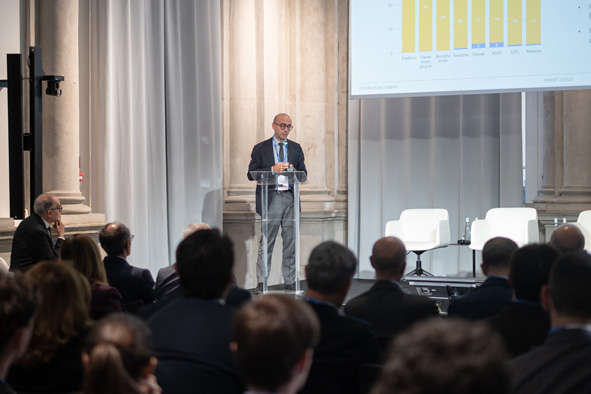
The Associate Professor at the Department of Energy is a member of the Management Committee and Science Communication Coordinator for COST Action CA25144. At the international IWPROBONO workshop, he presented the network and chaired a scientific session.
Organised within the framework of the COST Action PROBONO, the workshop brought together researchers studying proton-boron fusion and its potential applications. The presentation of ICED provided an opportunity to introduce the new network and initiate a dialogue with an international community working on related topics, including target design and development.
A network to address the challenges of target development
In inertial fusion, highly intense laser pulses are focused on a millimetre-sized target containing the fuel. Precision in target design and fabrication is essential for experiments. For this technology to advance, two challenges remain: developing targets with higher and more reproducible performance, and establishing manufacturing processes capable of producing them at a larger scale, with controlled quality and sustainable costs.
Running from 2026 to 2030, ICED brings together scientific and technological expertise to connect the different stages of this supply chain: from design and materials development to fabrication, handling and delivery of targets for experiments.
Alessandro Maffini’s role
Within the network, Maffini holds two roles. He is a member of the Management Committee, which helps guide and coordinate the Action’s activities, and serves as Science Communication Coordinator. In this role, he coordinates the network’s scientific communication and promotes consistency across the messages and materials shared by partners through their respective channels. He also contributes to the scientific activities of several Working Groups alongside other colleagues from the Department.
“To generate energy through inertial fusion in the future, we will need to continue improving target performance while making target production precise, reproducible and sustainable at scale. ICED brings together expertise from communities that currently work in different fields to tackle these challenges together,” explains Maffini.
The Department’s contribution builds on the expertise of the Micro- and Nanostructured Materials (NanoLab) group, which develops and characterises materials and studies their interaction with high-intensity lasers. ICED’s interdisciplinary nature also finds a natural home in the Department of Energy, where this expertise is integrated with research into nuclear fusion and, more broadly, energy technologies. Participation in ICED offers the Department an opportunity to help build a European research community and create opportunities for collaboration, training and mobility for early-career researchers and PhD students.
Le COST Action sono reti di ricerca e innovazione della durata di quattro anni finanziate da COST – European Cooperation in Science and Technology. Sostengono attività di collaborazione, formazione e scambio, mettendo in relazione persone e competenze e creando le condizioni per nuove iniziative scientifiche.