Emanuela Colombo in Brussels for Enifor 2025
The professor from the Department of Energy participated in the Sustainability Talk “Alliances for Development”, which focused on the role of international partnerships in strengthening local expertise and institutions.
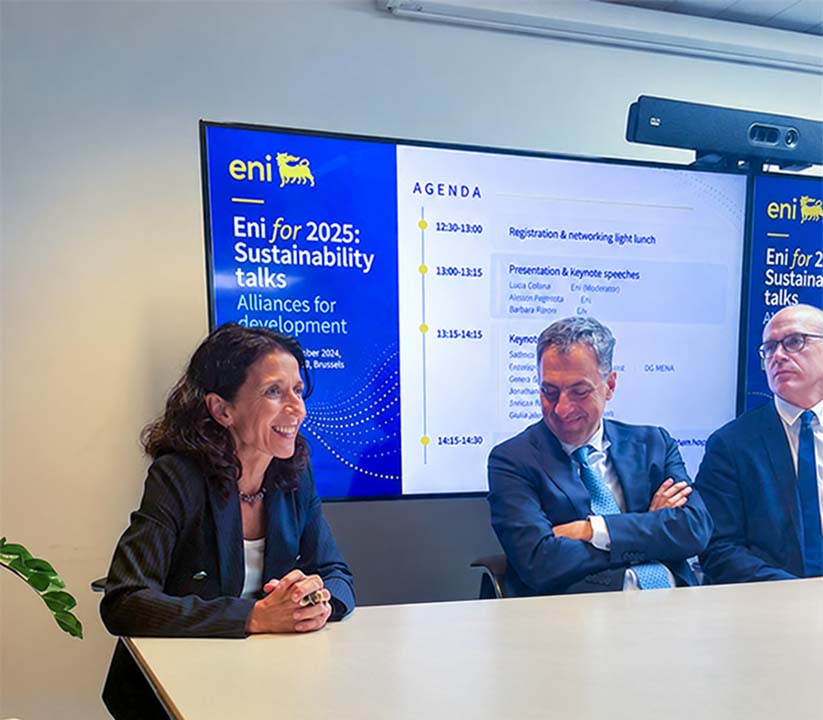
On 22 September 2026, in Brussels, Emanuela Colombo, Full Professor in the Department of Energy at Politecnico di Milano, Rector’s Delegate for Science Diplomacy and holder of the UNESCO Chair in Energy for Sustainable Development, took part in “Enifor 2025: Sustainability Talks – Alliances for Development”.
The event brought together representatives from Eni, the European Commission, the Italian Agency for Development Cooperation, AVSI Foundation, the United Nations Industrial Development Organization (UNIDO) and academia to explore how alliances between universities, businesses, institutions and civil society organisations can contribute to development processes.
In her speech, Colombo focused on what should remain after a cooperation project ends: not only completed activities, transferred technologies or trained individuals, but, above all, the ability of local communities and institutions to analyse problems, develop solutions and continue to innovate independently.
Central to her reflection was the concept of knowledge chain security, which connects education, research capacity and innovation for sustainable development. According to Colombo, the absence of any of these elements can create dependence not only on technologies developed elsewhere, but also on the ways in which problems, priorities and potential solutions are defined.
To make alliances for development effective, she identified three essential conditions: the co-creation of knowledge, the strengthening of institutional capacity and collaboration among different actors across the entire knowledge chain. An equitable partnership must contribute to local scientific sovereignty, understood as the ability to produce knowledge, identify priorities, design solutions and engage with policymakers.
Among the practical examples, Colombo highlighted the collaboration established in Egypt with Eni Corporate University to support SUT – ELSEWEDY University of Technology, Polytechnic of Egypt in designing a university programme in Energy Engineering Technology. Politecnico di Milano’s involvement extends beyond developing the curriculum to include analysing labour market needs, developing governance and quality assurance mechanisms, engaging with the private sector and training trainers.
A second example is ParTTEc, “Territorial Partnerships for the Ecological Transition in Tunisia: Co-designing People-centred Processes and Practices”, a project funded by the Italian Agency for Development Cooperation (AICS). The initiative brings together Tunisian institutions and several partners, including AVSI Foundation, the Municipality of Milan, Politecnico di Milano, Fondazione Politecnico di Milano and a local research centre, with the aim of supporting the implementation of Tunisia’s national strategy for the ecological transition.
In closing, Colombo stressed that alliances capable of delivering lasting results require shared values, trust and time. Only then can the expertise developed become firmly embedded in local institutions, enabling long-term autonomy and the capacity to innovate.