LABORATORI POLITECNICI: a look inside the Fluid Machinery Fluid Dynamics Laboratory (LFM)
A photograph by Giovanni Hänninen, created for the exhibition LABORATORI POLITECNICI, tells the story of the “behind-the-scenes” work of our Fluid Machinery Fluid Dynamics Laboratory (LFM), where experimentation and advanced simulation support the development of turbomachinery and energy technologies.
There is a world that is rarely seen from the outside: that of laboratories, where research takes shape among test rigs, measuring instruments, and everyday technical practices. The traveling exhibition LABORATORI POLITECNICI – departments | territory | education | technology, curated by Roberto Dulio and featuring photographs by Giovanni Hänninen, was conceived precisely to make this universe visible, conveying not only the technology itself but also the operational intelligence of the spaces where experimentation, measurement, and design take place.
Within this project, the Department of Energy contributed with the Fluid Machinery Fluid Dynamics Laboratory (LFM), a research infrastructure dedicated to the study and characterization (both experimental and computational) of the fluid-dynamic performance of turbomachinery and wind generators. Particular attention is given to flows in turbomachinery cascades, including transonic and supersonic regimes, as well as to the development and validation of advanced solutions for energy applications.
The photograph presented here — taken during the photographic campaign — invites viewers to look more closely at the “behind the scenes” of innovation: an innovation built on testing, data, modeling, optimization, and teamwork, where research and education continuously inform and reinforce one another.
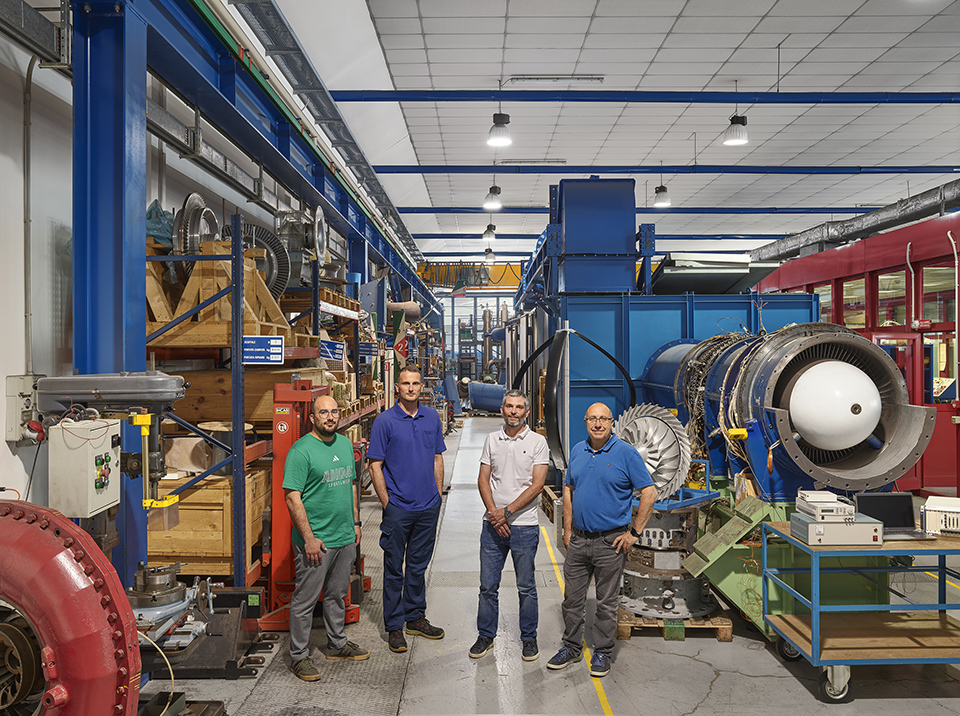
LFM | Department of Energy | from Laboratori Politecnici (2025) | Photograph by Giovanni Hänninen
The Fluid Machinery Fluid Dynamics Laboratory (LFM) of the Department of Energy is dedicated to the study of flows and performance in turbomachinery (turbines and compressors) and, more broadly, in energy conversion systems. The laboratory integrates experimental activity and numerical simulation (CFD) to analyze and optimize components and machine stages, including under complex flow conditions (up to transonic and supersonic regimes). Its research activities and testing infrastructures support both research and teaching in energy technologies, including applications related to wind energy as well as advanced fluids and cycles.